

Dagupan marks its 81st Liberation Day
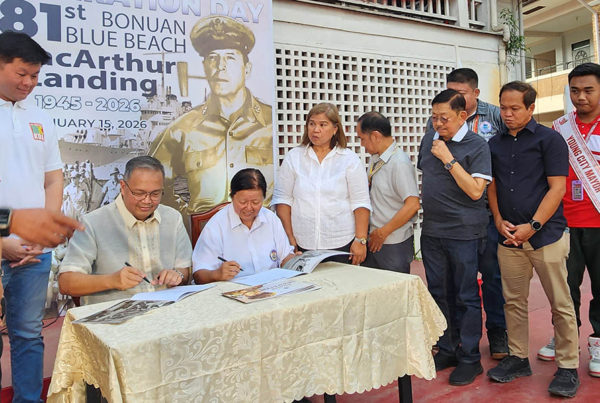
SPICED by lively folk dances and songs of the post-war era, Dagupan City commemorated the 81st anniversary of its liberation from Japanese occupation on January 15, 2026, honoring the historic Bonuan Blue Beach Landing that marked the return of Allied forces to Luzon during World War II.
Although Allied Liberation Forces under General Douglas MacArthur landed in Dagupan on January 9, 1945, historical records show that it was only on January 15 that residents gathered in large numbers—complete with a marching band—to celebrate their liberation.
The commemoration, led by Mayor Belen Fernandez, highlighted Dagupan Liberation Day as a significant milestone in the city’s history.
Miguel Angelo Villa-real, first vice president for marketing and corporate communications of the Philippine Veterans Bank, said that as many as 5,000 civilians joined American soldiers in honoring the liberation of Dagupan and nearby Pangasinan towns, citing James Zobel, chief archivist of the MacArthur Memorial in Norfolk, Virginia.
Villa-real made the statement during a program held at West Central Elementary School I, in front of the historic Home Economics Building that served as General Douglas MacArthur’s first command post in Luzon.
He recounted that despite injuries sustained from American shelling intended to dislodge Japanese forces along the coast days before the landing, residents welcomed the U.S. troops with joy and gratitude. Upon their arrival, locals immediately sought medical assistance for the wounded.
Many civilians were injured because they remained near the shoreline despite leaflets dropped by American forces warning residents to stay away. Villar-real noted that this behavior reflected the same resilience and defiance seen among people who ignore evacuation orders during typhoons.
According to Zobel, whose account was based on the diary of one of MacArthur’s fellow officers, Dagupan was the first place where MacArthur landed in Luzon—settling a long-standing historical debate that previously pointed to Lingayen, San Fabian, or Binmaley.
MacArthur’s flagship “Boise” really dropped anchors in Blue Beach, he said.
Villa-real also said the successful Leyte landing on October 24, 1944, paved the way for the larger Lingayen Gulf Landing, noting that Luzon housed the largest concentration of Japanese troops and wartime prisoners awaiting liberation.
The Home Economics Building that housed MacArthur for a few days, restored to its original design about five years ago, now serves as a heritage site in Dagupan City and stands as a reminder of the city’s role in World War II history.
Villareal further recalled MacArthur’s disagreements with then U.S. President Franklin D. Roosevelt and Vice President Harry Truman, who initially favored bypassing the Philippines in favor of a direct attack on Japan.
Had MacArthur failed to push for the liberation of the Philippines, he may not have fulfilled his famous promise, “I shall return,” which he declared during a press interview in Australia in 1942.
Mayor Fernandez said the present and future Dagupenos should be proud because of the pivotal role played by their beloved city in the liberation of the Philippines. (Leonardo Micua)